
SSC, ESC and GSA Discuss the Impact of Geopolitical Tensions on Global Supply Chains at SIL Barcelona 2026

As part of SIL Barcelona 2026, the Spanish Shippers’ Council (SSC), the European Shippers’ Council (ESC) and the Global Shippers’ Alliance (GSA) organized the conference “Global Supply Chains in a Context of Regional Tensions”, a forum dedicated to exploring the key challenges currently facing shippers and logistics operators in an increasingly uncertain geopolitical environment.

The session was moderated by Jordi Espín, Secretary General of SSC, and brought together a distinguished panel of industry experts. The event opened with a keynote presentation by Marta Torrents Fenoy, who provided a strategic overview of the legal and operational challenges affecting supply chains in today’s global landscape. This was followed by an insightful presentation from Godfried Smit, Secretary General of the European Shippers’ Council (ESC), who shared a European and international perspective on the evolution of global trade and the implications of growing regional tensions.

The subsequent panel discussion featured Mariuxi Chávez, Arturo Fernández, Mónica Viloria, and Ramón J. Pérez López, who shared their experiences and perspectives on how companies are adapting their logistics strategies to respond to an increasingly complex and volatile environment.

Throughout the session, participants examined critical topics including the impact of geopolitical conflicts on international trade flows, the growing vulnerability of global supply chains, evolving regulatory frameworks, and the need for organizations to strengthen their operational resilience.

One of the central themes of the discussion was the strategic role of data and digitalization in supply chain management. Speakers highlighted how visibility, data ownership, information control, and data-driven decision-making have become essential factors in maintaining competitiveness and improving adaptability across supply chains.

The conference underscored the importance of fostering collaboration between shippers, logistics operators, and institutions in order to anticipate risks, share knowledge, and build more resilient, efficient, and future-ready supply chains.

SSC would like to thank all speakers and participants for contributing to such a valuable and insightful discussion, as well as ESC and GSA for their collaboration in making this event possible.
Rail Situation in Catalonia – SSC Intervention on 3Cat Corporatiu

Our Secretary General, Jordi Espin Vallbona, participated in the program Els Matins on 3Cat Corporatiu to analyze the current state of rail traffic and its direct impact on logistics and the supply chain in Catalonia.

During his intervention, Jordi highlighted a reality the sector faces every day:

“Goods cannot complain, but they suffer the consequences.”

This phrase perfectly summarizes how capacity problems, lack of reliability, and congestion on the rail network affect not only passengers but also thousands of companies that rely on efficient transport to remain competitive.

At Spanish Shippers’ Council (SSC) – Transprime, we work to raise awareness of these challenges, bring them to the attention of authorities, and promote real solutions that strengthen resilience, sustainability, and competitiveness in logistics.

📺 We share the full video of the intervention.


Session at the Board of Directors of the Port of Barcelona – Presentation of the Shipper Of Trust Certificate (SOT)

On Thursday, January 29, we had the pleasure of attending, as the Spanish Shippers’ Council (SSC) – Transprime, the Board of the Port of Barcelona, in a particularly relevant and enriching session.

Our Secretary General, Jordi Espin Vallbona, presented in detail the Shipper of Trust Certificate (CCR), explaining what it is, what it entails, and why we firmly believe it represents a key element for the future of transport and logistics.

Through the CCR, we promote a clear vision: “Trust as the new currency.” Trust, ethics, resilience, and responsibility are no longer optional values, but central elements for building solid, sustainable supply chains ready to face current and future challenges.

It was a true pleasure to share this reflection within the framework of the Board, as well as to listen to the different voices of the port and logistics ecosystem in a well-structured session with highly valuable contributions.

We sincerely thank the Port of Barcelona for the invitation and the warm welcome, as well as all the speakers and participants. Without a doubt, it was a very interesting, inspiring, and rewarding day, reinforcing the importance of continuing to work together for more responsible logistics.

We continue.

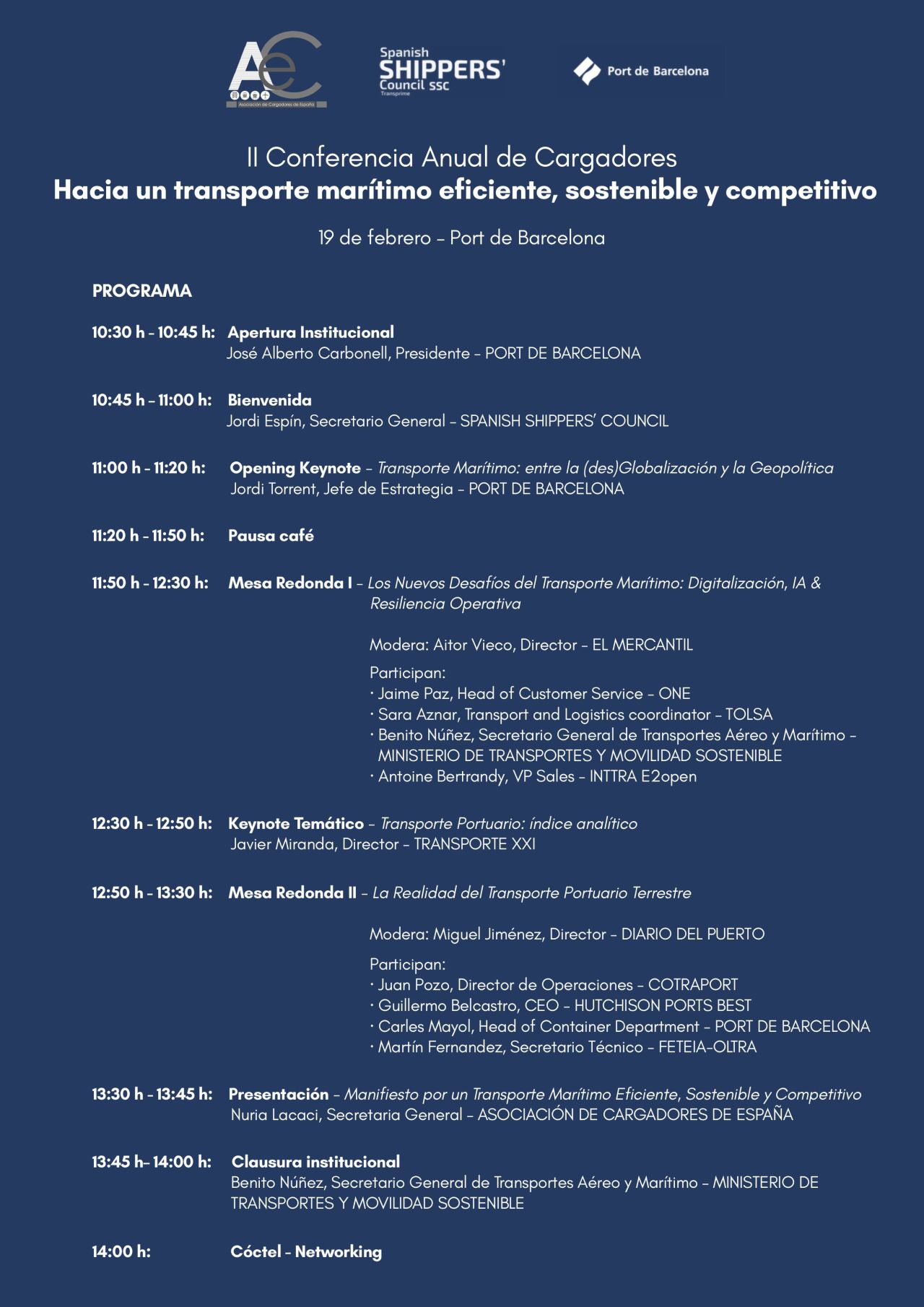
II Annual Shippers’ Conference

Port of Barcelona | February 19, 2026

On February 19, 2026, the Port of Barcelona will host the II Annual Shippers’ Conference, jointly organized by Spanish SHIPPERS’ Council (SSC) – Transprime and the Spanish Shippers’ Association (ACE).

Following the success of the first edition, this conference is now established as a key reference event for the maritime and port sector, in a context marked by geopolitical uncertainty, digital transformation, sustainability, and the growing need for operational resilience across supply chains.

Throughout the day, the main challenges and opportunities of maritime transport will be addressed through keynote sessions and panel discussions focused on:

  • The evolution of global trade and its impact on maritime transport.
  • Digitalization, artificial intelligence, and operational resilience.
  • The current reality and challenges of port-related inland transport.
  • Dialogue, collaboration, and networking among the main industry stakeholders.

Venue: World Trade Center Barcelona – Sala Barcelona

(North Building, 1st Floor)

Date: February 19, 2026

The full event program is available below.

To attend, prior registration is required via the following link:

👉 https://lnkd.in/gFD9t6fz

At SSC, we continue to promote spaces for reflection and collaboration to move toward a more efficient, sustainable, and competitive maritime transport sector.


Goods: a mistreated vital necessity

We have goods trapped—captive—within the swarm of blockages on the rail network. This causes those that still move by road to overlook the option of using the train, because neither the necessary capacity nor the adequate service is available. And when they decide to move by road, they face a serious blockage on the country’s main artery, the AP-7 southbound, forcing them to improvise and find alternative routes where no one dares to confirm anything: neither when, nor how, nor by which path the goods will arrive. Every day, drivers, planners, logistics managers, and operators have to find impossible solutions to deal with the disorder they encounter.

We rely on a logistics network managed by highly talented people with a strong vocation, who do the impossible to keep things flowing despite facing a complex operational framework generated by decisions—or inaction—of regulators, governments, administrations, and infrastructure managers. Ideas are projected from a laboratory far removed from reality, resulting in operational daily life that is hardly acceptable.

The daily movement of goods reflects the industrial vitality of a country, the bloodstream that keeps its productive economy alive. But who cares about that? Goods are inconvenient. Goods do not speak, do not complain, have no rights, and do not vote—unlike people. Does anyone take the side of goods? They bother us when they travel by truck on the highway, and also in the city. Trucks must always be moved aside to prioritize private vehicles, yet we expect products to arrive on time and be available on store shelves when needed. How do we reconcile this contradiction?

We need a national pact to protect goods, recognizing them as assets of industrial interest even while in motion. A pact that becomes a pillar of the new sustainability—not only environmental, but also social, ethical, and resilient—so that, together with drivers, the flow of products can move continuously, and goods stop being the scapegoat where all inefficiencies and externalities generated by political systems and infrastructure managers accumulate.

We also need the creation of continuous freight corridors. It is necessary to define strategic transport axes that cross the territory and receive priority attention, with reliable operational solutions, so that in the event of any disruption the default response is never to stop them. These corridors must ensure the continuity of the flow, just as private vehicles are managed, with temporary lanes opened in the opposite direction during return operations. For example, the AP-7 could have a southbound operational lane using the uphill lane: even if traffic is slower, the flow would not stop, avoiding the chaos in information and road conditions experienced by drivers and planners. Likewise, in situations of protests or blockades on main roads, freight drivers must be able to exercise their right to circulate and not be treated as expendable, left on shoulders or parking areas until allowed to resume work. Drivers are responsible professionals who accompany goods to their destinations and suffer, together with them, this constant waste of logistical effort, translating into lost hours and high economic costs.

It is also essential that trucks move onto the train. Rail highways along strategic transport arteries are an urgent necessity to relieve road congestion and save thousands of hours of unproductive driving. Continuing to postpone this scenario is to consciously accept a deficient rail system.

Through the global association of industrial companies that contract transport (GSA), we have promoted the Global Manifesto (Bill of Cargo Rights), a document establishing the principles and guarantees that must protect goods so they can continue generating wealth in the territories they transit, without being penalized by the logistics system itself. Just as manufacturing companies that contract transport voluntarily certify ethical, sustainable, and resilient logistics practices through the Shipper of Trust Certificate (CCR), it is necessary that policymakers and managers take note that governing and managing also involves assuming commitments, accrediting them, and guaranteeing real, ethical, and verifiable operational transparency.

Logistics sustainability is no longer an option — it is part of operational design

Last Monday, 15 December, the CEL Awards for Logistics Excellence were held, a benchmark event that highlights the projects transforming the logistics sector.

For Spanish SHIPPERS’ Council (SSC) – Transprime, this was a particularly meaningful occasion. After being awarded the CEL Sustainable Logistics Award in the previous edition, this year our Secretary General, Jordi Espin Vallbona, took part as a member of the jury and had the honour of presenting this year’s award.

🏆 The CEL Sustainable Logistics Award 2025, sponsored by Prologis, was granted to CHEP España S.A. for the project “AIRSHARED: Collaboration for more sustainable logistics”, an initiative that clearly demonstrates how collaboration and resource optimisation can generate a real impact in reducing the environmental footprint.

The award was received by Luis Sánchez, Collaborative Solutions Leader for CHEP Iberia.

👏 We would also like to congratulate the finalists in this category:

  • GMV and Passion Motorbike Factory – Scoobic, for the project“SCOOBIC MED: Autonomous, Electric and Connected Logistics Vehicle for Last-Mile Delivery”.
  • AR Racking | Storage Solutions, for“100% Human Automation: the AR Racking Factory”.

At Spanish SHIPPERS’ Council (SSC) – Transprime, we continue to advocate that sustainability, innovation and collaboration are key pillars for a more efficient, responsible and future-ready logistics sector.

Congratulations to all the award winners, and to the Spanish Logistics Centre (CEL) for counting on us and for continuing to promote excellence across the industry.

Sustainable Development Goals (SDGs)

On 19 November, we participated in an event organised by BCL – Barcelona-Catalunya Centre Logístic at the Consorci de la Zona Franca de Barcelona, focused on the implementation of the Sustainable Development Goals (SDGs) within the logistics sector.

The session brought together companies and organisations that presented real transformation projects linked to clean energy, innovation, training, climate action and strategic partnerships, clearly demonstrating that sustainability and competitiveness progress in parallel across the logistics value chain.

Spanish Shippers’ Council (SSC) – Second edition of the Shippers’ Corner

On 18 November, we took part in the second edition of the Shippers’ Corner, an event organised by the Spanish Shippers’ Council (SSC) in collaboration with Origo Partnership S.A., held at the Port of Barcelona. The session focused on the role of cargo as a key element in accelerating synchromodality across the supply chain.

The session was moderated by Josep Maria Fortuny Olivé, Senior Legal Advisor, and featured contributions from Joseph Santo, Director of Martico, S.L., and Jordi Espín Vallbona, Secretary General of the Spanish Shippers’ Council (SSC). They shared their perspectives on the current challenges faced by shippers and the need to move towards more coordinated and efficient logistics models.

Key topics discussed during the event included the make vs. buy balance, the importance of information flow and transparency among supply chain stakeholders, synchromodality as a new strategic standard, and the role of talent as a critical factor in strengthening resilience and competitiveness within the logistics sector.

Council Meetings

On 13 November, we participated in the regular ESC (European Shippers’ Council) Transport Councils meeting, a forum that brought together various European-level organizations to share experiences, best practices, and jointly reflect on the main challenges currently facing shippers across Europe.

The session enabled a highly valuable exchange of success stories and constructive discussions around key issues such as weights and dimensions, the Shippers of Trust initiative—the European designation of the Responsible Shipper Certificate (CCR)—the latest developments regarding ETS, customs cooperation, the Clean Corporate Fleets proposal, and the future of Combined Transport.

These Transport Council meetings continue to consolidate their role as a strategic platform to strengthen the voice of shippers before European institutions, foster cross-country coordination, and move forward towards a more responsible, sustainable, and efficient transport system.

Innovation, automation and sector collaboration in Seville

On 12 and 13 November, Spanish Shippers’ Council (SSC) – TRANSPRIME had the pleasure of taking part in the Innovation Tour “Challenges and opportunities of automation in logistics and supply chain”, organised by SSI SCHÄFER in Seville.

The event brought together leading industry experts —many of them members of our association— and highlighted the great potential of automation as a driver of logistics competitiveness and resilience.

The day began with a keynote speech by Miquel Serracanta Domènech, “Automation in Logistics / Supply Chain”, encouraging companies to move forward and step out of their comfort zone in order to build a more efficient, digital and sustainable supply chain.

We then had the opportunity to visit two benchmark facilities:

🍞 Grupo MAS – Automation of dry goods operations, including high-rotation storage and transport systems and automatic palletising solutions.

👕 Scalpers – Robotisation of its fashion warehouse with 12 RackBots, a clear example of continuous innovation and operational improvement.

We would like to express our sincere thanks to SSI SCHÄFER for their invitation and warm hospitality throughout the event.

SSC remains committed to promoting a more resilient, ethical and responsible logistics ecosystem, for the benefit of the entire community of shippers.